

1. Introduction
Modern banks face challenges in aligning data governance, enterprise architecture, and application integration.
Meeting regulatory demands, improving data quality, and achieving architectural consistency require a strong
business reference model combined with effective governance tooling.
This document introduces the BIAN Accelerator for Collibra, a structured approach to leveraging the Banking
Industry Architecture Network (BIAN) reference models inside Collibra Data Intelligence to deliver semantic
clarity, domain knowledge, and governance acceleration.
2. What BIAN Provides
BIAN is a global, vendor-neutral banking standard that provides:
- A Service Landscape (Business Areas → Business Domains → Service Domains)
- A unified Business Object Model (BOM)
- Standard Control Records, Behavioural Qualifiers, and Patterns
- A formalized semantic framework for banking
- A knowledge model of how banking capabilities, data, and processes interact
Together, these represent a complete reference architecture for banks.
3. BOM Structure Overview
The BIAN Business Object Model (BOM) organizes banking knowledge into a layered conceptual model:
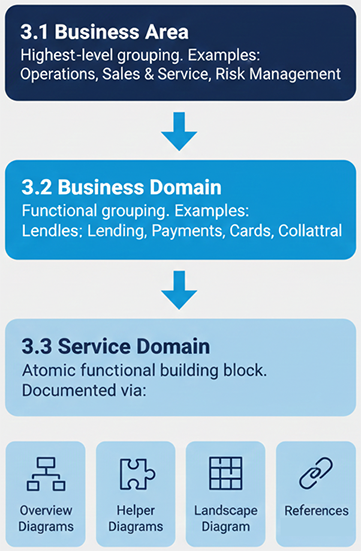
3.1 Business Area
Highest-level grouping of major banking capabilities.
Examples: Operations, Sales & Service, Risk Management.
3.2 Business Domain
A functional grouping within a Business Area.
Examples: Lending, Payments, Cards, Collateral.
3.3 Service Domain
An elemental or atomic functional building block (capability) that can be service-enabled as a discrete and
unique business responsibility.
It is documented via:
-
3.3.1 Overview Diagrams
High-level visual representations of key business objects and relationships within a domain.
-
3.3.2 Helper Diagrams
Supporting diagrams used to clarify shared patterns, object structures, and cross-domain commonalities.
-
3.3.3 Landscape Diagram
The complete Service Landscape that positions all service domains across Business Areas and Business Domains.
-
3.3.4 References
Mappings and traceability elements linking business objects to Service Domains, APIs, patterns, and external standards.
4. Semantic Value BIAN Brings to Collibra
Although BIAN’s deeper value lies in knowledge, its semantic contributions are foundational:
4.1 Common Banking Vocabulary
Provides standardized definitions for core terms like Account, Customer, Facility, Agreement, Transaction.
4.2 Canonical Data Objects
A consistent library of business objects aligned to banking best practices.
4.3 Structured Domain Hierarchy
A clean, hierarchical data catalog aligned with BIAN’s Service Landscape.
4.4 Integration with API Standards
BIAN’s detail extends to semantic API payload structures, supporting API governance in Collibra.
These semantic assets accelerate data cataloguing and glossary build-out.
5. Knowledge Value BIAN Brings to Collibra
Beyond semantics, BIAN brings deep encoded industry knowledge that Collibra can operationalize. This is where real enterprise value emerges.
5.1 Domain Knowledge
BIAN defines what capabilities should exist in a bank and how they relate, providing a complete capability map for Collibra communities and domains.
5.2 Process & Lifecycle Knowledge
Control Records encode lifecycle stages, events, and business responsibilities (e.g., Origination → Fulfillment → Monitoring → Closure).
5.3 Data Flow & Interaction Knowledge
BIAN defines how Service Domains exchange information, enabling Collibra to capture lineage and dependencies.
5.4 Organizational Knowledge
Clear responsibility allocation allows Collibra to assign ownership roles and steward responsibilities based on best practice.
5.5 Architectural Knowledge
BIAN shows optimal service boundaries, enabling alignment between data governance and enterprise architecture.
5.6 Knowledge Graph Foundation
The BOM functions as an industry-specific knowledge graph. Collibra can ingest this structure to create a unified ontology for banking.
6. How BIAN Accelerates Collibra Implementation
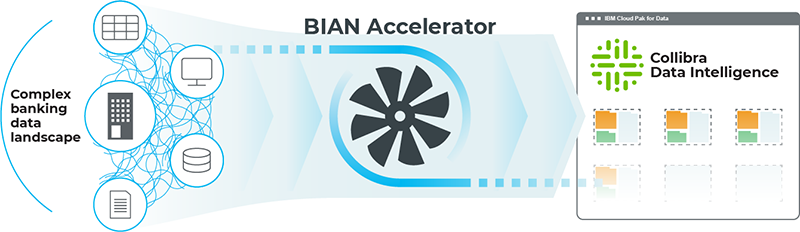
The BIAN Accelerator for Collibra produces concrete benefits across governance, quality, lineage, architecture, and compliance.
6.1 Accelerated Operating Model Setup
BIAN provides a ready-made structure for:
- Communities
- Domains
- Glossaries
- Conceptual models
- Ownership roles
6.2 Faster Data Quality Rule Development
BIAN definitions are precise enough to serve as templates for quality rules.
6.3 Stronger End-to-End Lineage
Cross-domain interactions from BIAN map directly into Collibra lineage diagrams.
6.4 Better Regulatory Reporting
Regulatory requirements (e.g., BCBS 239, KYC, AML, GDPR) rely on traceability—BIAN improves it, Collibra documents and governs it.
6.5 Enhanced API Governance
BIAN semantic APIs and payload definitions integrate cleanly into:
- Collibra API catalogues
- Data contracts
- Technical lineage
6.6 Enterprise Architecture Alignment
Collibra, data governance teams, and architects use the same language and structure.

7. Mapping BIAN to Collibra
| BIAN | → | Collibra |
|---|---|---|
| Business Area | → | Collibra Community |
| Business Domain | → | Collibra Domain |
| Service Domain | → | Collibra Subdomain or Asset Type |
| Business Objects | → | Collibra Glossary / Conceptual Models |
| Control Records | → | Collibra Operating Models |
| API Models | → | Collibra Technical Assets |
| Cross-domain flows | → | Collibra Lineage |
This mapping transforms Collibra into a banking knowledge platform.
8. Deliverables in a BIAN Accelerator Package
A full accelerator includes:
- Collibra-ready import files (glossary, domains, business objects, relationships)
- A BIAN-based knowledge graph model
- Prebuilt lineage templates
- BIAN glossary and definitions
- Semantic API catalogue assets
- Ownership and stewardship models
- Ongoing curation processes
9. Conclusion
BIAN and Collibra are complementary:
- BIAN provides the banking knowledge and semantic architecture.
- Collibra activates and governs that knowledge across the enterprise.
Together, they provide banks with a powerful accelerator for:
- data governance maturity
- regulatory compliance
- operational efficiency
- architecture modernization
- semantic and knowledge alignment
Contact & Support:
The BIAN Accelerator for Collibra turns industry best practice into actionable governance structures.